
Italy · Europe
Trapani, Italy: FlyGo.si destination guide
Trapani is a compact port city on Sicily’s west coast with a strong sense of place: salt pans, sea views, Baroque streets and easy access to beaches, islands and hill towns. It works well for travellers who want a slower Mediterranean base rather than a rushed city break. This guide covers what to see, when to go, how to get around and where to stay, with practical tips for independent visitors planning a trip to Trapani.
Find flights to Trapani ↓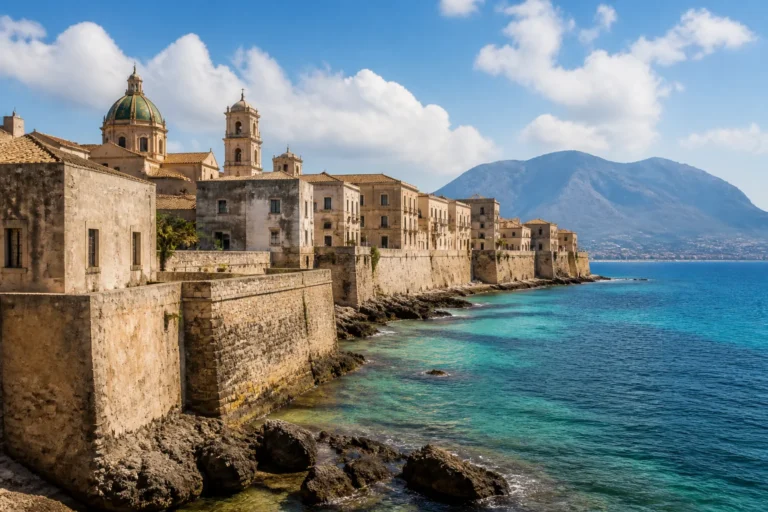 AI illustration
Find flights to Trapani
Compare flights · EURAbout Trapani
Trapani sits on a narrow strip of land between the Tyrrhenian and Mediterranean seas, and that coastal setting shapes much of the city’s appeal. The historic centre is easy to explore on foot, with pale limestone buildings, churches, small piazzas and long seaside promenades. It is not a large sightseeing city, which is part of the attraction: many travellers use it as a relaxed base for exploring western Sicily.
The city’s identity is closely tied to the sea, salt production and fishing, and you can still see that in the working harbour and the salt pans to the south. Trapani also has a practical side for visitors, with ferry links to the Egadi Islands and road access to Erice, Marsala, and other nearby destinations. For independent travellers, it offers a good balance of urban convenience and easy day trips.
- Historic centre that is manageable on foot
- Strong base for islands, salt pans and hill towns
- A port city with a working, everyday atmosphere
Things to do in Trapani
Start with the old town, where narrow streets lead to the port, churches and waterfront. The atmosphere is strongest in the early evening, when locals and visitors come out for a stroll. Walking the promenade is one of the simplest pleasures here, especially if you want open sea views without committing to a full beach day.
The salt pans south of the city are one of the most distinctive landscapes in the area. Even if you do not enter any visitor facilities, the flat pans, windmills and reflective water make for a memorable excursion, especially around sunrise or late afternoon. From Trapani, many travellers also head to Erice, the hilltop town above the coast, for cooler air, views and a change of pace. The Egadi Islands are another major draw, reached by ferry and best suited to a full day or longer if you want to slow down.
If you like low-key sightseeing, consider combining a harbour walk, a market stop and a meal based on local seafood or Sicilian specialities. Trapani is less about headline attractions and more about atmosphere, scenery and straightforward access to the coast and islands.
- Walk the historic centre and harbourfront
- Visit the salt pans for a distinctive coastal landscape
- Take a ferry to the Egadi Islands or a trip up to Erice
Best time to visit Trapani
Trapani is most appealing when the weather supports walking, swimming and outdoor time, but the best period depends on your priorities. Spring and early autumn are often the most comfortable choices for sightseeing and day trips, with warmer temperatures but generally less pressure than the peak summer months. These shoulder seasons are also good for combining the city with beaches, nature and island visits.
Summer brings the fullest seaside atmosphere, longer evenings and the busiest transport connections, but also more heat and more people in popular spots. Winter is quieter and can work well if you are focused on culture, food and relaxed city time rather than beach activities. If you plan to use ferries or regional transport, it is sensible to check seasonal schedules carefully, since services may vary through the year.
- Spring and early autumn suit sightseeing and day trips
- Summer is best for a full coastal atmosphere
- Check seasonal transport timetables before you book around island trips
How long to stay in Trapani
A short stay in Trapani can work if you want a base for one or two focused outings, but the city rewards a slower pace. One full day is enough for the old centre, harbour and promenade, while two to three days gives you time for salt pans, Erice and a ferry trip if the timings suit you. If your trip is built around beaches or island-hopping, staying longer can make the logistics much easier.
For travellers exploring western Sicily more broadly, Trapani is often most useful as part of a small itinerary rather than as a standalone city break. A few nights here can connect neatly with Marsala, the archaeological sites in the wider region, or a longer stay on one of the Egadi Islands.
- 1 day for the centre and waterfront
- 2–3 days for key day trips
- Longer stays work well for a western Sicily itinerary
Airports and transport
Trapani is served by Trapani–Birgi Airport, which is the most convenient air gateway for the city. From there, onward travel is usually by taxi, shuttle, car hire or pre-arranged transfer, depending on your plans and the services operating at the time of travel. Palermo is also an important arrival point for western Sicily, especially if you are comparing flight options or planning a wider island trip.
In the city itself, walking is often the easiest way to get around the centre and waterfront. Local buses can help with some cross-town journeys, while ferries connect Trapani with the Egadi Islands. If you want to explore salt pans, beaches or inland towns at your own pace, a car can be useful, though parking and historic centre access may be less convenient in busy periods. For current schedules and ticketing, it is best to check official transport operators before you go.
- Trapani–Birgi is the closest airport
- Walking suits the centre and seafront
- Ferries and regional transport are key for day trips
Where to stay in Trapani
For first-time visitors, the historic centre is usually the most practical place to stay. You will be close to restaurants, the harbour and the main evening atmosphere, and much of the city can be explored without relying on transport. This area suits travellers who value convenience and want to be able to step out for dinner or an early ferry.
If you prefer a quieter base or a more beach-oriented stay, look at the areas nearer the waterfronts outside the densest centre or toward the coast south of town. These can work well for longer stays and for travellers with a car. Harbour-adjacent areas are useful if you are planning island trips, while a stay closer to Erice access can suit visitors combining city time with sightseeing inland.
Families and slower travellers may appreciate accommodation with easier parking and simpler road access, while solo travellers often prefer central locations for walkability and evening life.
- Historic centre for convenience and atmosphere
- Harbour areas suit ferry departures
- Coastal or edge-of-centre stays can be quieter
Practical tips for Trapani
Trapani is straightforward to visit, but a little planning helps. If you are using ferries or regional buses, do not assume frequencies will be the same year-round. Check timetables with official providers, especially for island day trips, and allow flexibility if you are combining multiple legs in one day. The same applies if you are relying on a rental car, as driving and parking can be easier outside the tightest parts of the centre.
Pack for walking and strong sun in the warmer months, since the most pleasant way to experience the city is often on foot between the centre, harbour and seafront. A stop in a local café or bakery can be a practical way to build your day around sightseeing rather than rushing from one landmark to another. If you plan to visit Erice, remember that temperatures and conditions can feel different at altitude, so it is worth carrying an extra layer even on a mild day.
For many visitors, the best approach is to treat Trapani as a compact base rather than a place to over-schedule. Leave space for a harbour walk, a slow meal and one or two good excursions, and the city tends to feel more rewarding.
- Check ferry and bus timetables in advance
- Expect to walk a lot in the centre
- Use Trapani as a base for a slower itinerary
Frequently asked questions about Trapani
Is Trapani a good base for western Sicily?
Yes. Trapani works well as a base if you want easy access to the Egadi Islands, the salt pans, Erice and other parts of western Sicily without changing hotels too often.
Can you explore Trapani without a car?
You can cover the historic centre on foot and use ferries or some public transport for selected day trips. A car is helpful for wider exploration, but it is not essential for a short city stay.
How far is Trapani from Erice?
Erice is close by, but the exact travel time depends on how you go there and where you start in Trapani. Check current transport options or road access before you travel.
Is Trapani mainly a beach destination?
Not only. Trapani has coastal appeal, but many visitors come for the old town, harbour atmosphere, salt pans and easy day trips rather than for beach-only holidays.
Are the Egadi Islands worth visiting from Trapani?
They can be, especially if you enjoy ferry trips, clear coastal scenery and a slower pace. Whether they fit your itinerary depends on your travel time and seasonal ferry services.
What type of traveller suits Trapani best?
Trapani suits independent travellers who like compact cities, coastal scenery and flexible day trips. It is a good fit if you want a practical base with a local feel rather than a large resort.
Travel information can change. Check official transport operators and attraction websites before booking.
Editorial review: 23 Oct 2026
More destinations to explore
 AI illustration
Alghero
Alghero, on the north-west coast of Sardinia, combines a historic centre with easy access to beaches and the coastal…
Explore destination AI illustration
Bari
Bari is a practical, characterful gateway to Puglia, combining a walkable old town, a lively waterfront and an easy…
Explore destination AI illustration
Bologna
Bologna is one of Italy’s most rewarding city breaks: compact enough to explore on foot, lively without feeling overwhelming,…
Explore destination AI illustration
Cagliari
Cagliari is Sardinia’s lively capital, where a compact historic centre, long city beaches and easy access to turquoise coastline…
Explore destination